


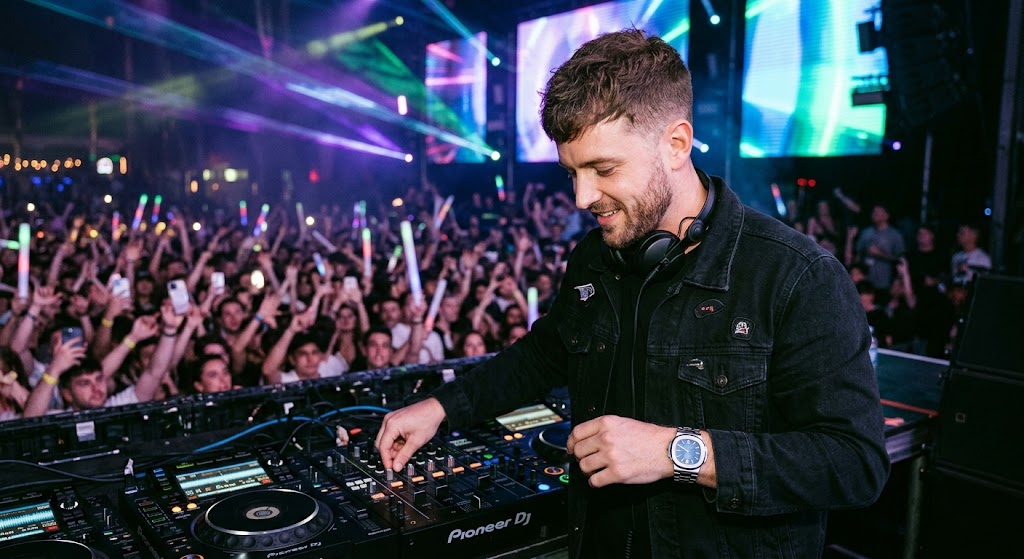
Music moves culture. And nowhere does that cultural influence land more tangibly — or more expensively — than on a musician’s wrist. Long before watch brands started writing massive sponsorship checks, musicians were organically making certain timepieces famous. Jay-Z wore an Audemars Piguet Royal Oak Offshore before most of hip-hop had heard of it. John Mayer mentioned a green-dial Rolex Daytona in a watch interview and its market value jumped by roughly $20,000 virtually overnight. Kanye West wore a Cartier Crash at a time when the entire watch world was obsessed with diamond-encrusted sports pieces — and quietly predicted the Crash’s cultural renaissance years before it arrived. The relationship between music and watchmaking is one of the more fascinating stories in modern luxury culture, and it runs deep across every genre. From EDM producers sporting custom Hublots in Ibiza to vintage jazz legends who made the Breitling Navitimer iconic before aviation enthusiasts got to it, musicians have always had a unique relationship with fine timepieces. They aren’t just wearing status symbols — they’re making statements about identity, craftsmanship, and what it means to value something beyond the moment. This guide covers the most iconic luxury watch pairings in music history, the stories behind them, what each piece says about the artist wearing it, and what you need to know about each watch if you’re considering one for yourself. Whether you’re a serious collector, a music fan with an eye for detail, or an EDM head who just noticed something gleaming on your favorite DJ’s wrist at Ultra, this is the definitive resource. The Most Influential Watch Collector in Music History John Mayer occupies a category entirely his own in the intersection of music and horology. GQ called him the “Watch World’s Most Influential Collector” — and that title isn’t hyperbole. His collection, valued at an estimated $31 million as of 2025, spans vintage Rolex Daytonas, Patek Philippe complications, and Audemars Piguet Royal Oaks, but what makes Mayer different from every other celebrity collector is the effect his taste has on the broader market. The clearest example: when Mayer praised the yellow gold Rolex Daytona Ref. 116508 with a Christmas-green dial during a Hodinkee Talking Watches episode, the secondary market price jumped from roughly $34,000 to nearly $50,000. The watch became so associated with his endorsement that collectors began calling it the “John Mayer Daytona.” That’s not celebrity branding — that’s genuine horological authority. The Watches: Why It Matters: Mayer’s collection is a masterclass in how to move from “first good watch” (his Rolex Explorer II bought with his first record deal paycheck) to a multi-million dollar archive of horological history. His approach — deep research, genuine enthusiasm, storytelling — is the blueprint for any serious collector. The Man Who Brought AP to Hip-Hop Before the Audemars Piguet Royal Oak became the definitive hip-hop status symbol — appearing in hundreds of songs by everyone from Drake to Kendrick Lamar to Future — there was Jay-Z, wearing it in the early 2000s when luxury watch culture in hip-hop was still dominated by oversized Rolexes and iced-out custom pieces. Jay-Z didn’t just wear AP — he collaborated with it. In 2006, he and the Swiss manufacturer released the Royal Oak Offshore “Jay-Z” 10th Anniversary Limited Edition: 100 pieces total, split across stainless steel (50), rose gold (30), and platinum (20). The Arabic numeral “10” was set in diamonds, and each came with a 40-gigabyte iPod loaded with his complete discography. It remains one of the most storied artist-brand watch collaborations ever produced. The Watches: Why It Matters: Jay-Z’s AP adoption didn’t just reflect his taste — it shaped hip-hop’s horological vocabulary for over a decade. The dozens of AP references in rap lyrics that followed his lead are a direct testament to cultural influence operating at the highest possible level. The Rose Gold Standard Drake’s watch identity is inseparable from Rolex, and within Rolex, it’s inseparable from rose gold. He’s been photographed in rose gold Daytonas, wore one on the cover of Take Care, and has been spotted in a Yacht-Master II and multiple Day-Date variants over the years. What makes Drake’s collection interesting beyond the flex is the depth of his vintage interest — he owns a rare 1970s Oyster Quartz, a model that sits outside the typical celebrity wish list entirely. His Patek Philippe holdings are equally notable. Drake was spotted wearing an emerald-encrusted Nautilus 5726/1A Annual Calendar in black DLC with green gemstones covering the case, dial, and bracelet — a customized piece with an estimated value in the millions. His Audemars Piguet Royal Oak includes a custom brushed stainless steel dial variant, further distinguishing his collection from the standard AP that appeared on every celebrity wrist in the 2020s. The Watches: Why It Matters: Drake’s watch choices consistently push outside the standard celebrity playbook. The vintage Oyster Quartz in particular signals that his collection runs deeper than mere status acquisition. The Only Musician With His Own Richard Mille Pharrell Williams doesn’t just wear Richard Mille — he has a watch named after him. The RM 52-05 Tourbillon Pharrell Williams is one of only a handful of signature RM pieces ever produced for an artist, placing him in elite company alongside athletes and racing drivers. The watch features one of Richard Mille’s signature smiling skull motifs with Pharrell’s distinctive aesthetic infused into the design. His broader collection reflects the same genre-defying eclecticism that defines his music. He wears a diamond-set Casio G-Shock alongside an Audemars Piguet Royal Oak Concept Carbon — two pieces that couldn’t be more different on paper but somehow make complete sense on the same wrist. Additional Richard Mille pieces in his collection include the RM 70-01 Alain Prost and RM 25-01 Adventure. The Watches: Why It Matters: Pharrell’s watch choices perfectly mirror his music: simultaneously reverent of craft and completely unbothered by rules. The Watch Move Nobody Saw Coming In 2019, Kanye West showed up wearing a Cartier Crash — a surrealist, asymmetrical case inspired by a melted watch — at a moment when every other rapper in his orbit was commissioning diamond-covered sports watches. At the time, the Crash was a collector’s darling but far from the cultural flashpoint it would later become. Kanye wearing one in the era of maximum bling was an act of contrarianism that, in retrospect, perfectly predicted the Crash’s massive secondary market boom that followed. His watch history is extensive and eccentric. He gifted the sound engineers on the Watch the Throne album custom Rolex GMT Master watches as a thank-you for not leaking tracks — the most expensive “thank you” note in album history. His personal collection includes a customized Tiret with his face silhouetted on the dial (18-carat gold, eight carats of mixed-color diamonds, $180,000 commission, five months to complete), a gold Rolex Daytona, and an all-black customized Submariner. The Watches: Why It Matters: Kanye’s Crash moment was one of the clearest examples of a musician moving a market through genuine personal taste rather than brand alignment. It’s the watch equivalent of wearing an obscure sample before it became a hit. EDM’s Most Decorated Watch Ambassador David Guetta’s relationship with TAG Heuer is the deepest music-watch partnership in EDM history. Not only did he co-design a signature model — the TAG Heuer Formula 1 David Guetta Special Edition (Ref. WAZ201A.FC8195) — but he became a formal brand ambassador during a period when TAG was actively working to attract younger, music-oriented audiences to the brand. The co-designed piece features dual-time functionality built for the international touring life, a black-and-blue color scheme symbolizing the day-to-night rhythm of a DJ’s world, and 45mm case sizing that makes it impossible to miss. His personal collection extends to Hublot’s Big Bang Unico, a watch whose “Art of Fusion” philosophy — combining unexpected materials in bold ways — mirrors his approach to music production. Carbon fiber cases, ceramic bezels, and skeleton dials in a package that performs technically while looking like a statement: that’s both the Big Bang Unico and a David Guetta DJ set. The Watches: Why It Matters: Guetta’s TAG Heuer partnership helped bridge the gap between luxury watchmaking and the electronic music world at scale, attracting a generation of EDM fans to horology who might never have engaged with the category otherwise. The Youngest DJ in the Watch Ambassador Game When TAG Heuer CEO Jean-Claude Biver brought Martin Garrix on as a brand ambassador, Garrix was barely 20 years old and ranked third on DJ Mag’s Top 100. Biver saw in him exactly what the brand needed: a young, globally relevant face whose audience was the next generation of luxury consumers. The partnership framed TAG Heuer’s brand philosophy — “Swiss Avant-Garde Since 1860” and “Don’t Crack Under Pressure” — through the lens of a DJ who had already played the Jimmy Fallon Show and was selling out venues worldwide before graduating high school. Garrix visited TAG Heuer’s workshops in Switzerland, spending time with watchmakers in the ateliers asking questions about movement mechanics that reportedly surprised the craftsmen with their depth. His ambassador watches span the Formula 1 and Aquaracer collections, timepieces that balance the brand’s performance heritage with the kind of contemporary energy that resonates with his fanbase. The Watches: Why It Matters: Garrix and Guetta’s TAG Heuer partnership helped make luxury watches relevant to the EDM generation. Walk into any major festival and you’ll find fans who got curious about watches because of their favorite DJ’s wrist. Gold Standard in More Ways Than One In January 2025, Rihanna was photographed strolling through Harlem wearing a customized Rolex Midas — the only Rolex model designed by Gérald Genta, creator of both the AP Royal Oak and the Patek Nautilus. The solid-gold Midas had been a relatively under-discussed Rolex model before Rihanna brought it into mainstream visibility. Genta designed it in 1973, and in a market obsessed with steel sports watches and Datejusts, the Midas had been quietly appreciated by a niche collector community. Rihanna changed that overnight. Her watch choices across red carpets and street style appearances have consistently been notable — she gravitates toward pieces with historical weight rather than pure commercial visibility. The Watches: Why It Matters: The cultural leverage Rihanna applied to the Midas follows the same pattern as Mayer’s green Daytona: a genuine personal taste choice by someone with massive visibility revives collector interest in an overlooked reference. “Damn, My AP Goin’ Psycho” The opening line of Post Malone and Ty Dolla $ign’s “Psycho” — “Damn, my AP goin’ psycho” — became one of the most famous watch references in modern music, mentioned seven separate times in the track. Whether the “AP” in question was specifically an Audemars Piguet Royal Oak or a composite cultural signifier barely matters: the song put AP into conversations among fans who had never considered fine watchmaking as relevant to their world. Post’s personal collection leans into the same ostentatious-but-considered aesthetic that defines his public persona. His Rolex Daytona Rainbow — the same 36-baguette-sapphire bezel model worn by Mayer, David Beckham, and Kevin Hart — is one of the most consistently spotted pieces in his rotation. The Watches: Why It Matters: “Psycho” did more for Audemars Piguet brand awareness in its first month of chart performance than most marketing campaigns accomplish in a year. Jazz Legend, Timeless Choice Long before EDM producers were sporting six-figure sports watches, the most stylish musicians on earth were wearing Breitling Navitimers. Miles Davis — widely considered not only the greatest trumpet player in history but one of the most stylish men of any era — wore a Breitling Navitimer Ref. 806 as a near-constant companion across several decades of his life. The 806, introduced in 1954, is a pilot’s chronograph with a circular slide rule bezel for airspeed, fuel consumption, and other aviation calculations. On Davis’s wrist — typically on a Bund-style leather strap — it was less a tool and more a philosophical statement: precision, rhythm, and the belief that function and beauty are not opposing forces. For watch collectors, the Davis association has made the Navitimer 806 one of the most revered references in vintage Breitling collecting. The Watches: Why It Matters: Davis’s Navitimer is proof that the music-watch connection isn’t a modern phenomenon — it has always been about artists who recognize that a great watch, like a great musical phrase, is impossible to improve. Rock & Roll’s Most Elegant Contradiction The go-to timepiece for rock and roll’s most enduring bad boy was a gold Cartier Panthère — as unexpected as it is perfect. The Panthère is delicate, almost jewelry-like in its construction, with a supple gold bracelet that moves like liquid and a case that prioritizes elegance over any functional complication. Everything about it contradicts the leather, skull-rings, and decades of reported excess that define the Richards public mythology. And yet, there it was on his wrist throughout his 1980s heyday, more recognizable on him than it had been on anyone else. The Panthère has experienced a significant modern revival, with both Cartier relaunching updated versions and the vintage market for original examples surging. The Richards association — an artist choosing beauty over status, elegance over spectacle — is central to understanding why the Panthère means something that transcends its modest complications. The Watches: Why It Matters: Keith Richards wearing a Panthère is a reminder that the most interesting watch choices are often the most counterintuitive ones. We The Best… Wrist DJ Khaled has built one of the most enthusiastically documented watch collections in the music industry, which is entirely consistent with a career built on enthusiastic documentation of personal achievement. His AP collection is extensive, and his social media posts about watches have introduced his audience — one of the largest in music — to high-end horology in the most accessible, celebratory way possible. The Royal Oak is his signature, typically in stainless steel or rose gold, worn alongside a personality that treats every watch acquisition as an event worthy of the same excitement as a Billboard chart position. His collection also includes multiple Rolex Day-Dates, a watch whose formal, presidential design sits in interesting contrast to the bombastic energy of his public persona. The Watches: Why It Matters: Khaled’s relationship with watches functions as an education for his massive audience. His unfiltered enthusiasm makes luxury horology accessible in a way that traditional marketing has never managed. EDM’s First Global DJ, Watch-Ready Since Day One Tiësto has had watch partnerships and collaborations throughout his career, including a notable limited-edition collaboration with Guess that produced a 45mm gunmetal PVD timepiece with an oversized crown, patterned dial, and electric blue seconds hand bearing his logo on the caseback — an accessible piece designed for his fanbase rather than the watch collector community. Off the stage, his personal taste has trended toward the larger, bolder segments of the luxury market, consistent with the aesthetic that has defined his performances across every major festival in the world. His wrist has been spotted with pieces from brands including Richard Mille and Rolex, where the scale of the watch matches the scale of the sets. The Watches: Why It Matters: Tiësto’s Guess collaboration remains one of the few direct EDM-watch design partnerships, and his influence on the scene’s appetite for luxury carries significant horological weight. The Song That Made Hublot Famous The 2011 track “Otis” from Watch the Throne contained a Hublot reference that, according to Google Trends data, doubled search interest for the brand for months after the song charted. Researchers found that the Hublot name surge tracked almost perfectly with the Billboard Hot 100 chart position of the song — a cleaner demonstration of how music drives luxury market behavior than any academic study could manufacture. Hublot’s presence among musicians has grown substantially since, with the brand’s “Art of Fusion” philosophy — combining unexpected materials like rubber, ceramic, carbon fiber, and precious metals — naturally attracting artists who think similarly about genre-blending in their work. The Big Bang, with its tonneau-adjacent case and skeleton dial options, has become one of the defining luxury sports watches of the last decade, with music world adoption playing a central role in that rise. The Watches: Why It Matters: The “Otis” Hublot moment is one of the most analytically documented examples of music driving luxury market behavior, a case study referenced in watch industry circles to this day. The Guitar Player With a Seven-Figure Wrist Ed Sheeran’s watch collection has received significant attention over the past several years, particularly his Richard Mille pieces — a brand that, until recently, was primarily associated with Formula 1 drivers and professional athletes. His Patek Philippe holdings are similarly substantial, placing him alongside Mayer, Jay-Z, and Drake in the tier of musicians who have made serious investments in horological heritage. What makes Sheeran interesting as a collector is the contrast between his musical identity — accessible, emotionally direct singer-songwriter — and his watch taste, which skews toward the most technically extreme and visually dramatic pieces produced by either brand. Richard Mille’s use of aeronautical-grade materials, sapphire crystal cases, and tourbillon movements is about as far from an acoustic guitar as horology gets. The Watches: Why It Matters: Sheeran’s collection challenges assumptions about which musicians are serious watch people. The most commercially accessible pop star on the planet has one of the most technically demanding watch collections in music. Understanding which brands dominate music culture gives context to the full picture: Rolex remains the foundation of virtually every music-world collection. The Day-Date, Daytona, Submariner, and GMT-Master appear across hip-hop, pop, rock, and EDM. Its combination of universal recognition, investment performance, and range of price points makes it the default starting point and often the most cherished long-term hold. Rolex holds roughly 32% of the luxury retail watch market globally — and a considerably higher share of celebrity wrists. Audemars Piguet Royal Oak became hip-hop’s defining luxury sports watch through Jay-Z’s early adoption, with references proliferating across rap lyrics from the early 2000s forward. The Royal Oak’s octagonal bezel, integrated bracelet, and Grande Tapisserie dial are now as recognizable in music culture as any album artwork. Patek Philippe sits at the apex of prestige in music collections, with the Nautilus serving as the particular touchstone — its secondary market explosion, driven in part by hip-hop references and collector demand, made it one of the most discussed luxury objects of the 2020s. Richard Mille has the highest average price point of any brand in music collections, and its adoption by Pharrell (signature model), Sheeran, and others reflects the brand’s success positioning itself as the ultimate expression of technical watchmaking for people who reject traditional status signaling. Cartier occupies a unique space — the Crash (Kanye), the Panthère (Keith Richards), and the Tank remain beloved across different generations of musicians, often as counterintuitive choices that reflect depth of taste. TAG Heuer holds a specific place as the primary EDM-facing luxury brand, anchored by David Guetta and Martin Garrix’s ambassador relationships, and represents the most accessible entry point to genuine Swiss luxury watchmaking for the festival audience. Hublot thrives at the intersection of music and sports, with the Big Bang’s material fusion concept resonating with artists who think about genre-blending in similarly bold ways. The best music-watch pairings share a few consistent qualities. They reflect something genuine about the artist’s identity rather than a simple price-based flex. They often involve watches with technical or historical depth that rewards attention — the same quality that defines great music. And they tend to be chosen by people who could wear literally anything, which is precisely why their choices carry weight. For EDM producers performing at 2 AM in front of 50,000 people under a light rig, the watch is often the only detail of personal style visible from a distance. For rappers who have built entire aesthetic worlds around the details of luxury culture, the watch is a chapter in a larger autobiography. For guitarist-collectors like Mayer who have built their entire public identity around the pursuit of mastery — in music, in wine, in motorcycles, in watches — the timepiece is a direct expression of a life philosophy. The connection between music and fine watchmaking isn’t accidental. Both are crafts where mastery is invisible to the casual observer and obvious to anyone who has spent time learning the depth of the field. Both reward obsession and punish indifference. And both, at their best, make you feel something that is genuinely difficult to describe in words. The data is clear: when the right musician wears the right watch, markets move. John Mayer’s green Daytona endorsement drove secondary prices up by more than 40%. Jay-Z and Kanye’s Hublot reference in “Otis” doubled Google search volume for the brand. Drake’s emerald Nautilus created secondary market demand for similar custom configurations. Rihanna’s Midas brought a forgotten Genta design back to collector consciousness. For anyone building a watch collection in 2026, paying attention to what serious musicians wear — not just what brands are paying for placement, but what artists genuinely gravitate toward when money is no object — is one of the clearest windows into where the market is heading next. The musicians on this list aren’t wearing watches because they were asked to. They’re wearing them because they understand, intuitively, what every great collector eventually figures out: a truly great watch, like a truly great song, communicates something that can’t be said any other way. Best Luxury Watches Loved by Famous Musicians & Producers 2026
1. John Mayer — The Rolex Daytona & Patek Philippe Nautilus
2. Jay-Z — Audemars Piguet Royal Oak Offshore
3. Drake — Rolex Collection & Patek Philippe Nautilus
4. Pharrell Williams — Richard Mille RM 52-05 (Signature Model)
5. Kanye West — Cartier Crash
6. David Guetta — TAG Heuer & Hublot Big Bang
7. Martin Garrix — TAG Heuer
8. Rihanna — Rolex Midas
9. Post Malone — Audemars Piguet Royal Oak
10. Miles Davis — Breitling Navitimer 806
11. Keith Richards — Cartier Panthère
12. DJ Khaled — Audemars Piguet Royal Oak Collection
13. Tiësto — Custom & Luxury Collaborations
14. Kanye West & Jay-Z — Hublot (Watch the Throne)
15. Ed Sheeran — Richard Mille & Patek Philippe
The Watch Brands That Musicians Love Most: A Quick Reference
What Makes a Watch “Right” for a Musician?
Final Thoughts: Music Moves the Watch Market