


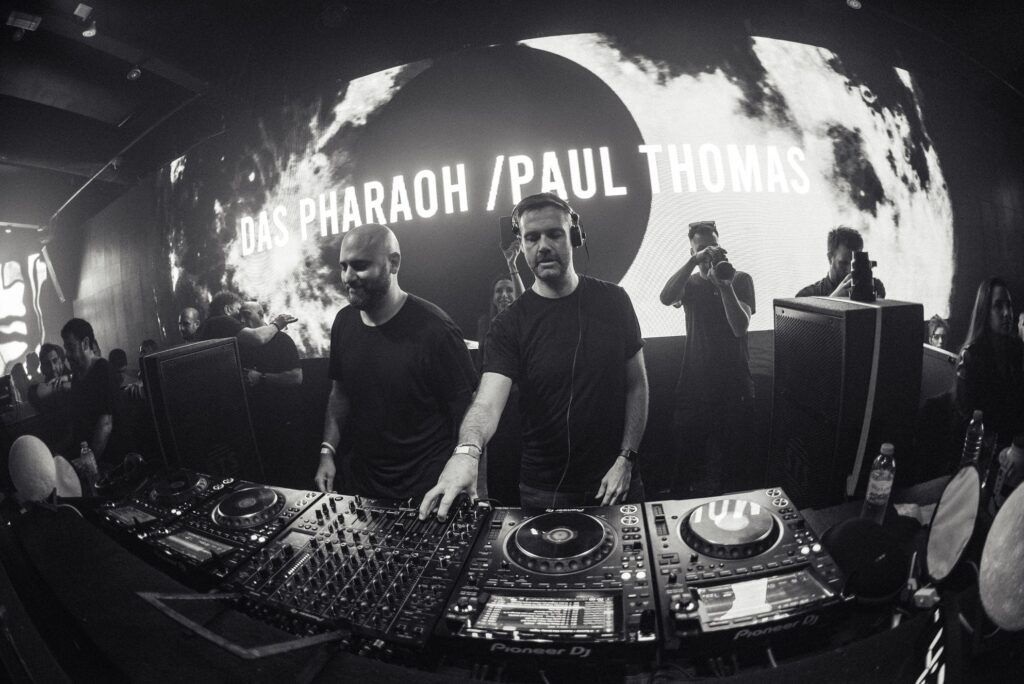
Here’s one of the best interviews we’ve had, tapping into the Progressive space. Welcome, fellow readers, to our first interview of 2026. We are starting the year on a powerful note with two absolute legends of the scene. They are not only prolific producers but the minds behind one of the most influential labels in Progressive House today. Please welcome to EDMTunes, Paul Thomas and Das Pharaoh, also known as the force behind UV. If you’ve been stuck in time for some reason, let me bring you up to speed: on the one hand, Paul has spent over two decades shaping the most beautiful corners of electronic music, since his start as a partygoer in the 90s and subsequent evolution to producer, becoming an icon of the Progressive movement. He’s got a fascinating story which I’m not going to spoil for you, since we’ll discuss it down below. Wink wink. Joining him is an artist you likely recognise as Fadi from the world-conquering Trance duo Aly & Fila. Hailing from Egypt, Fadi has reached the pinnacle of the global music stage, and has now branched out and embarked on a solo journey as Das Pharaoh. This project has one single constraint: total creative freedom, allowing him to explore a deeper space in the Progressive scene that he hadn’t fully tapped into before. Together, these two legends (and close friends too) are leading an entire movement through their esteemed label UV, formerly FSOE UV, a rebrand which we’ll also talk about later on, so no spoilers for you. You just have to dive into it. In the lines you’re about to read, we talk about everything regarding this chapter in their lives, including the transition from UV Radio to their more grounded and introspective podcast, Underground Live Forever (ULF). We discussed the whys and hows behind their collective and individual careers, and exactly what it is about the Progressive sound that keeps them so inspired. I can honestly say this was one of the best interviews of my career; the chemistry between the three of us was something rare, a dynamic I can count on the fingers of one hand. Thanks so much for coming guys, it’s truly a pleasure. Well, the first thing we have to address is, huge congratulations on the launch of the ULF podcast! Paul: Thank you so much! It’s been a long journey to get to this point. We’re talking eight or nine months of solid work in one way or another. Honestly, I didn’t realise quite how much work it was going to be. If I had, I probably wouldn’t have done it! [Laughs] But it’s been a good time and it’s been very well received. Fadi: Especially if we end up doing it every week like that. But it’s really cool. We both agree that this is what the scene needs, the Prog scene really needs this kind of attention. We need programs that make the sound more familiar to people who don’t know it yet. Could you give us some insight into how it came to be? You mentioned it was nearly a year of work, but what sparked the idea to shift from the purely audio-based UV Radio to a full video podcast? Paul: Fadi and I have been talking for years about having something within our brand that stands out, something different beyond just putting out music and throwing parties. I was actually out running one day — I usually get my best ideas when I’m running — and it just came to me: we should do a video podcast. I ran it by Fadi, he loved it, and we just rolled with it. Fadi: Coming from the Trance scene, I’ve watched what Armin van Buuren has done with A State of Trance. Regardless of whether you like the music or not, the idea of that video podcast is essential for the genre. When Paul told me his idea, it was like a “boom” moment. I realised we didn’t have anything like that in the Progressive scene. I told him, “Paul, let’s do it. We need to do it.” You guys have been partners for a while now. I’m a bit out of touch because I’m coming from a Trance background and just recently getting into Prog through some Argentinian friends, five years or so. Have you guys always worked together, even back when it was FSOE UV? Paul: I’ve known Fadi for a long, long time. I used to be a resident at Godskitchen here in the UK, and Fadi used to play there an awful lot. But we never really sat down and had a proper chat back then, did we? Fadi: No, we were colleagues, but we weren’t “proper friends” yet. Paul: Exactly. Then, we were both DJing at a festival in India in 2017. We were chatting backstage, and Fadi told me he’d always loved a wide range of music and wanted to launch a Progressive label. A lightbulb went off in my head because I was looking to start work on a new project at the time. I sent Fadi some music- Fadi: And I loved it! I was like, “Wow, this is exactly what I want.” Paul: The funny thing is, right before that, I had been dabbling with Trance and I’d sent him some music without him even knowing it was me. It wasn’t very good, Fadi will be honest about that! So, for me to send him the stuff that was actually from my heart, the stuff I really wanted to make, and for him to like it… that’s when I knew this could work. We met in Amsterdam a few months later, came up with a plan, and launched the label in the summer of 2017. We haven’t looked back since. Fadi: Paul had a label before called Ultraviolet. When we met, we were thinking of a name for the new venture, something that still felt connected to something, and we just decided to stop Ultraviolet and start UV. Paul: Initially, it was part of FSOE (Future Sound of Egypt), but we eventually decided it needed its own entity and its own life. We decided to separate it because the sound is just completely different. I’d argue that the shift to just “UV” gave it its own personality. It feels more free. To me, and I think to the charts as well, UV has become one of the true trailblazers of the genre. Paul: Thank you, I appreciate that. Becoming a standalone was important. Don’t get me wrong, the FSOE attachment gave us a brilliant push at the start—it probably would have been much harder to grow as quickly as we did without them. But over time, you want the focus to be on UV itself. It has become one of the leading labels in its own right. Back to the shift from UV Radio to the UV Podcast. What does a podcast offer that a normal radio show doesn’t? Why cater to the “insight” side rather than just the music? Paul: A couple of reasons. One: the visual aspect. We know how important visuals are for promotion on Instagram, YouTube, and TikTok. Fadi: It’s more interactive. Paul: Exactly. People want to see who is behind the DJ. It creates a connection more than just a voice. You see the mannerisms—Fadi is one of my best friends, so it’s essentially just two best friends chatting in a studio. People like the human aspect of that. Secondly, for the artists we bring in, it’s not just a guest mix anymore. You get to know them, their ethos, and where they come from. Fadi: It’s about making a better experience for the listeners. The video idea was more effort and more work, but it’s 100% more rewarding. Paul: Anyone can put out a mix every week; there are hundreds of DJs doing that. This is completely different. We’ve doubled our YouTube subscribers in just two weeks, and that’s with only one episode out! I’ve got to say, though, we were a bit anxious to get the podcast out to the world before anyone else had the exact same idea and just beat us to it. [Laughs]
I’ve noticed a real demand lately for this kind of “insightful” product. I can understand the nerves, though: you recorded those first episodes in Amsterdam in October at ADE and then had them packed away for two entire months before the launch, that’s bonkers. Paul: Yeah! It’s because I never want to dictate to artists what they can play. So we had to wait until the shows were recorded to get tracklists and start the licensing process. Across three episodes, that was six hours of music to license. Armada has been amazing and really helpful, but editing and PR logistics just take time. It was worth the wait. Now we’re looking forward. We’ve already planned out most of 2026. Fadi: We definitely want to make it weekly at some point. We’re currently planning how to fit that into our schedules and lives. Paul: That’s how important it is. I totally understand now why Armin and the ASOT team focus so much on it. It’s the core of the brand. I like that we have both sides of this spoken product now in the Progressive scene. I interviewed Will from Super Progressive back in May, and he’s been skyrocketing. And he represents the passionate fan/listener side, while you guys are running the business, moving the pieces of the checkerboard in a way. It’s two different angles that are very useful for the scene. Paul: Will was actually very helpful with advice when we were in the planning stages for this. He’s a wonderful guy. We really want this show to be about the whole industry, not just DJs. Record label owners, promoters—we want to hear everyone’s story. We want fans to learn the wider story of Progressive. It’s an entire ecosystem. Incredible, I just love how closely knit the Dance community is, even more in our corners of it, namely, Progressive, Trance, you name it. Let’s move on to the label itself now. What does it take for a demo to sound “UV-ish” to you guys? What makes a track worthy of signing? Paul: Honestly, it’s just got to be good. We listen to the groove just as much as the melody. Lately, the melodic stuff we’re doing is probably a bit more subtle compared to when we first launched. I wouldn’t say it needs to fit a specific “bracket,” but generally, the UV main label is a bit warmer and lighter, while UV Noir is darker and more club-focused. Fadi: What I love about UV is that it has a signature sound, but it isn’t repetitive. You can hear a track and know it’s a UV release, but it doesn’t sound like every other track on the label. Many well-known labels become too repetitive in my opinion. UV is broad. Any favourite songs from the label’s history? Either your own or from your colleagues? Paul: From my own music, the stuff I’m making right now is my favorite of my whole career. It’s deeper, subtle, and very groove-led. As for other artists… God, I feel bad picking one! Cendryma has had a wonderful 18 months, we’ve pushed him across both labels. Fadi: M.O.S, obviously Trilucid. Paul: Yes, we’ve had them since the early days. We could go on, and this is why I love Progressive, everyone has their own sound. Fadi has been working on his Das Pharaoh sound for years and years, and now he has a trademark sound that doesn’t sound like anyone else. Same with Blake Jarell, Cendryma, and Trilucid. I like to think that I’ve got my own sound as well. Fadi: If I have to pick, I’d pick Blake Jarell’s last release, ‘In The End You’ll Know’. For me, it was absolutely top. Paul: Blake is very analogue. She uses a lot of analogue hardware, and you can just hear that richness. He launched his career as Armin’s tour DJ but then locked himself away for years to learn everything about production and hardware. His music naturally stands out because it’s so warm and analogue-ey compared to everyone else. ‘In The End You’ll Know’ is originally a James Holden record. As soon as you hear it, you’ll understand what I mean about that beautiful, analogue sound. Fadi and I have played it countless times. Fadi: Blake’s a guy who deserves to do really well. He’s a genius, in my opinion. Now, since you guys are now a source of inspiration to so many artists, I would love to ask, who were the artists that influenced your sound when you started? Paul: For me, it was Sasha. Without a shadow of a doubt. In the late 90s, I was fully immersed in Trance, it was huge in the UK then. I used to go to a night called Gatecrasher every week, that one and Godskitchen, both from my hometown of Birmingham. And then one night, Godskitchen booked Sasha for his Global Underground: San Francisco tour. I’d never heard of him. He played much slower, much more textured music. I remember standing there thinking, “Is this ever going to get going?” because I was used to 140 or 145 BPM, and he was at 126 or 128, which was painfully slow back then. I bought the CD a few weeks later just because, and I bet I listened to it constantly all day, from disc one, start to end, disc two, start to end, back to disc one, start to end. That CD completely changed me and my taste. Completely. Overnight, my taste switched. From that day on, all I cared about was Progressive, all the music I listened to, all the vinyls I bought. Fadi: For me, it started a long time ago too. Progressive House was very popular in Egypt back then with the Global Underground tours. I used to go to those parties with my friends and got really interested, even though I was a Trance DJ and producer. But then I saw Hernán Cattaneo for the first time, and it just clicked. I realised, “I want to do this myself”. I wanted that sound coming out of me. And the funniest part about this, I told myself one day I wanted to do a track that actually Hernán would play. A few years later, Paul actually sent a track of mine to Hernán a day before his show in Amsterdam. I went to the show the next day, and Hernán played it. That must have been an incredible moment. Fadi: The track is called ‘Watt Is Right?’. The name came after this moment, it really felt like I was doing what was right. Paul: I remember that night clearly. I sent it to him the day before and wasn’t expecting him to play it at all. Hernán is my favorite DJ by far right now. He’s been incredibly supportive of the label and the podcast. Fadi: He’s such a cool guy. A proper Argentinian cool guy. He, Nick Warren… they’ve all been really supportive. But Hernán is the Maestro. That guy is so neat when he mixes. I remember a stream he did at the AEP airport in Argentina in August 2020 while we were all locked away. He played a track in that set—he tends to keep IDs to himself for years, you’ll know that. This one track just did something to me. I could never forget it. After all these years I still don’t know what it is! Paul: I remember that set! It was a Cercle-like setting, wasn’t it? Amazing. What’s your approach to making music? Do you go in with an idea, or start from scratch? Paul: Sometimes I have something in my head, but it’s mostly dependent on the mood. I often start with a MIDI patch for inspiration. Lately, I’ve been listening to old vinyls for ideas. Not the main leads of course, but ideas for the percussion or one-shots. I also have a lot of badly hummed voice notes on my phone. Fadi: Same for me, I go with the flow. I’ll open a keyboard or a VST and just go through sounds until one clicks. Paul: [to Fadi] You’re also really good at getting inspired by travelling and shows. Fadi: I always travel with my production laptop. I always have it with me. And it made a huge difference for me: I can produce everywhere now, which is amazing. Paul: We’ll be at ADE or travelling for a gig, Fadi will have an amazing weekend, and a week later he’ll say, “Listen to this!”. He gets so inspired by seeing other artists and events. Fadi: Party hard, then produce! [Laughs]
Not a bad way of life, you know? Now, do you remember a specific time in your career when you felt you had something truly magical in your hands? Maybe a melody or a project where you just thought, “This has the potential to be huge”? Paul: I remember when I wrote a record called ‘Tomorrow’ with Jerome Isma-Ae, which released on Toolroom. I had written most of the idea and was searching for a lead melody. I was flipping through a sample pack—do you remember the Vengeance packs? They were probably the most overused samples ever 15 years ago. I was clicking through chord one-shots, and I hit five different chords in a row. I just went, “Fuck”. I played them again and realised, that’s the lead. Fadi: Jesus. [Laughs]
Paul: I didn’t even fully understand it at the time! I sent it to Jerome, and completely by chance, he found an African vocal sample that fit the key and progression perfectly. This was before Splice or readily available packs. It was just meant to be. Fadi: Honestly, for me, a melody usually happens right in the studio. I don’t often have those “run to the laptop” moments outside of it. With the Das Pharaoh project, there’s no plan. I enter the studio just to have fun and see what happens. Paul: To add to that, in terms of live shows, the UV Boat Party at ADE 2023 was probably my favourite set I’ve ever played in 25 years of DJing. When Fadi and I play back-to-back, we never talk about what we’re going to play. We just vibe. During that five-hour set, we didn’t discuss direction or BPM once, we were just totally in tune. I came away from that so inspired, realising we were onto something special. Fadi: I don’t usually play B2B with many people, but Paul is definitely the one I love playing with the most. It just works. Paul: The first time we did it was in Miami in 2018. I asked Fadi a few days before, “When should I come to your hotel to go through music?” and Fadi just said, “No, we’ll just play and see what happens.” That was the only conversation we’ve ever had about track selection, never again. One of us starts, we follow the vibe, and that’s it. It’s crazy when that chemistry is just there. Fadi: Definitely. You can’t force it, and for us it just happens. Paul: It helps that Fadi is one of my best friends. We speak almost every day. When you know someone that well, you understand them without them having to speak, not just in music, but in everything. Fadi: It shows on stage. The crowd feels that energy and connection. You can’t fake that stuff. Looking back at your career, what is one thing that happened that you totally didn’t expect and surprised you for the good? Paul: Bumping into Fadi and starting this new chapter. It sounds a bit corny, but it came at a time when a major project had just finished and I needed something new for my own well-being. I wasn’t expecting it to happen the way it did. Fadi: It just had to happen. Everything went so smoothly. Paul: Exactly. We could have been playing different set times in India; I could have just passed him backstage and that would be it. The fact that things aligned the way they did… that’s easily the best thing that’s happened to my career. Fadi: And having Paul join the team, and now becoming an owner of the company, what he’s done for the whole brand, including Future Sound of Egypt, has been an unbelievable change. Things are completely different now. Paul: The stars aligned. I’ve realised that whenever something has gone wrong in my life, there’s always been something on the other end to pick me up. Fadi: Everyone gets those chances, but the difference is whether you see them. Many people ignore them or are too afraid to take them. Paul: You’re right. Sometimes it’s about taking the chance even if it’s outside your comfort zone. Doing this video podcast was completely out of my comfort zone because I’m not great in front of the camera. I was so incredibly nervous for that first episode. Fadi: I was nervous too! And English is my second language, so I’m always worried about making mistakes. But getting out of your comfort zone is how you succeed. You won’t succeed sitting comfortably on the couch. There was this interview that they did to Richard Hammond, one of the Top Gear former hosts. Diary of a CEO if I’m not mistaken. And Rich said something that got engraved in my head. He said “I believe luck comes to everyone. Everyone gets lucky at some point. It’s just how you take it, if you take it or you leave it. That’s what determines if that spike of luck stays a spike or turns into something that you can actually sustain. Fadi: Yeah, I definitely agree. Because I’ve seen it. I’ve seen it with my own eyes. Final question, I’m afraid, but definitely my favourite. If you could go back in time any number of years you’d find interesting and meet your younger self, what would you tell that younger you? Were you perhaps too anxious or worried about something that wasn’t necessary? Paul: I’d go back to a very specific moment 15 years ago. I had signed a cover of Energy 52’s ‘Café del Mar’ to Spinnin’ Records, mind you this was before the time when people made covers, it was something new. I hadn’t actually signed the physical contract yet, and my friends at Toolroom asked if I wanted to put it out with them instead. I took it off Spinnin’, and they were so angry, they were fuming. Then, because the original artists were so pissed that I’d pulled it from Spinnin’ (Energy 52), they refused to clear the sample for Toolroom. I regret it to this day. That record would have sent me into the stratosphere, similar to what ‘Man with the Red Face’ did for Mark Knight and Funkagenda, they did a Laurent Garnier cover and blew up completely. So I’d go back, slap myself, and say: “Leave it with Spinnin’!”. Fadi: For me, I’d go back to the start of Aly & Fila. I used to listen to everyone criticizing me. I’d focus on the one or two negative comments instead of the thousands of good ones. Even if one person said something negative about a set or a track or whatever, it used to really hurt. But after a long time, I learned to just do what I wanted. Do what you need to do, because you will never please everyone. I’d tell my younger self: “Chill, relax, it’s okay, just think about the positive side.” You can never please everyone. I think there’s so many artists that are starting that are fragile to that treatment. Those kinds of things can kill their drive. When you’re starting, you don’t have confidence, you don’t know if you are really good at what you do or not, you don’t have credit, nor backing. Paul: Social media now can be a vicious place as well. Fadi: Exactly. Especially now with social media, you can see everything. Paul: Going with your gut is the best advice. With experience, you learn to listen to that feeling of when things are right. Two very good stories. That’s why I always like to ask this question, because I believe that by you guys looking back, there’s also something that our readers can actually take into their own lives as sort of lessons. Guys, thank you so much for this interview, I’ve had the time of my life. I love these laid-back chats. Thank you both so much. Fadi: It was really good, thank you too. Paul: Thanks man. It was great. To wrap things up, I want to express what a true pleasure it was to speak with these guys. I can’t remember another interview where I felt quite so warm and welcome from the very first minute. The energy was unmatched, largely because Paul and Fadi aren’t just colleagues—they are best friends. That bond made my job easy, sparking a conversation that felt much less like a formal Q&A and much more like a relaxed chat between old friends, even though they were the only old friends, as they’d met me ten minutes before the interview itself. We laughed, we shared stories, and we spoke with a level of warmth that I cherish immensely. This all perfectly encapsulates what I love about my corner of the Electronic music industry: there are no rockstars here. We are friends and we are colleagues, cheering for each other’s rises without a hint of envy. This ego-free environment is a gift to artists, managers, and fans alike. It holds true to the idea that music is meant to soothe our pains and bridge the divides that the world so often brings to us. To everyone involved in making this happen—thank you. And stay tuned to EDMTunes for more.[INTERVIEW] Paul Thomas And Das Pharaoh Talk UV, ULF Podcast, Careers, And More
The Interview


Final Words

